
River & Village – The Water That Had Nowhere to Go
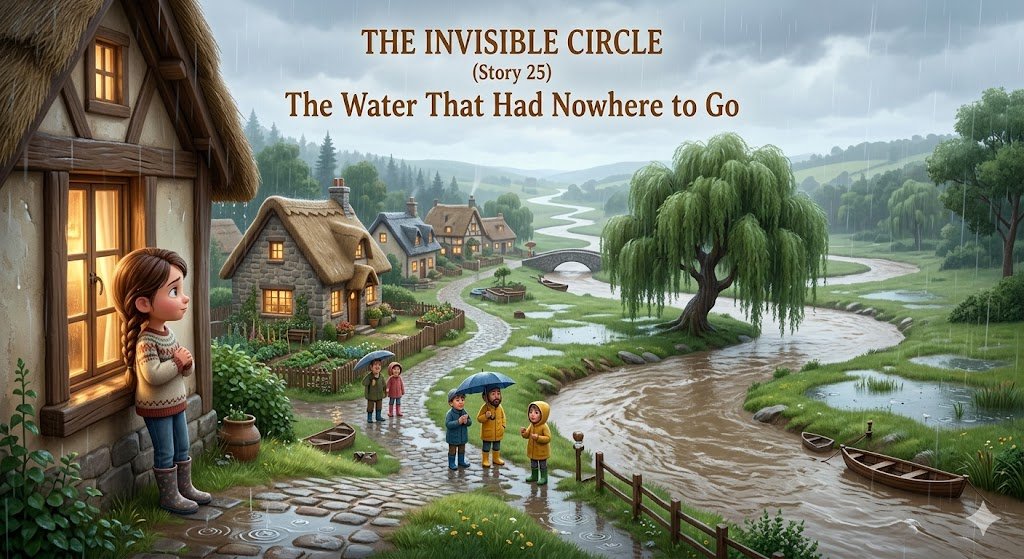
“I’m not trying to stay,” said the water.
“I’m trying to move.”
The rain began before sunrise.
At first, it was gentle.
Drops landed on leaves. They tapped softly on rooftops. The fields welcomed them. The river opened her arms.
“Take your time,” the river said.
The rain smiled.
“I always do.”
But high above, dark clouds continued to gather.
More rain arrived.
Then more.
Then more.
The river lifted her head.
“This is becoming a lot.”
In the hills, water raced down slopes.
In the fields, soil tried to drink.
“We’re full,” the soil whispered.
“Already?” asked the rain.
“We haven’t had enough time.”
The water kept coming.
Normally, some would sink into the ground.
Some would rest among roots.
Some would slowly find streams.
But things had changed.
The soil near the village was harder now. Paths had become wider. More land was covered. Fewer places remained where water could pause.
“I need somewhere to go,” said the rain.
The ground had no answer.
Soon, small puddles appeared.
Then larger ones.
Then the puddles joined hands.
The child stood by the window watching.
“The yard is becoming a pond,” they said.
Outside, the river felt pressure building.
Water rushed toward her from every direction.
“Slow down,” she called.
“We can’t!” shouted the runoff. “There’s nowhere else!”
The river stretched wider.
She bent where she could.
She filled old channels.
She entered places she remembered from long ago.
But the village had forgotten them.
Water reached roads.
Then gardens.
Then doorsteps.
The villagers hurried outside.
“Where is all this coming from?” someone asked.
The river looked surprised.
“From the sky,” she replied.
“But we’ve always had rain.”
“Yes,” said the river gently. “And I’ve always had space.”
Now many of those spaces were gone.
The wetlands that once held water had shrunk.
The grassy patches that slowed runoff had disappeared.
The old floodplain where water rested had been built upon.
The water had lost its waiting rooms.
By afternoon, the rain finally slowed.
The clouds drifted away.
The river breathed deeply.
Slowly, the water began to retreat.
Puddles shrank.
Roads reappeared.
The village remained standing.
But something had changed.
That evening, the child walked beside the river.
“Were you angry?” the child asked.
The river laughed softly.
“No.”
“Then why did you come into the village?”
The river thought carefully.
“Because I had nowhere else to go.”
The child sat quietly.
Nearby, an old willow tree nodded.
“She isn’t your enemy,” said the willow.
“She isn’t?”
“No. She was looking for the places that once belonged to her.”
The child looked across the land.
At the roads.
The houses.
The missing grass.
The filled-in wet places.
For the first time, the child saw the village differently.
Not as separate from nature.
But as part of it.
The next day, people gathered.
“What can we do?” they asked.
The river smiled.
“Give water room.”
Some listened.
Small ponds were restored.
More trees were planted.
Low areas were left open.
The work was slow.
But the water noticed.
“I can breathe again,” she said.
And when the next rain arrived, the land welcomed it more gently.
Because water does not ask for much.
Only a path.
Only a pause.
Only a place to belong.
🌱 The Invisible Circle – For You
Water is not the problem.
The problem begins when it loses the places that help it move safely.
When nature has room to work,
everyone benefits.

Review THE INVISIBLE CIRCLE – Story 25.