
The Tree Who Spoke Through Its Roots
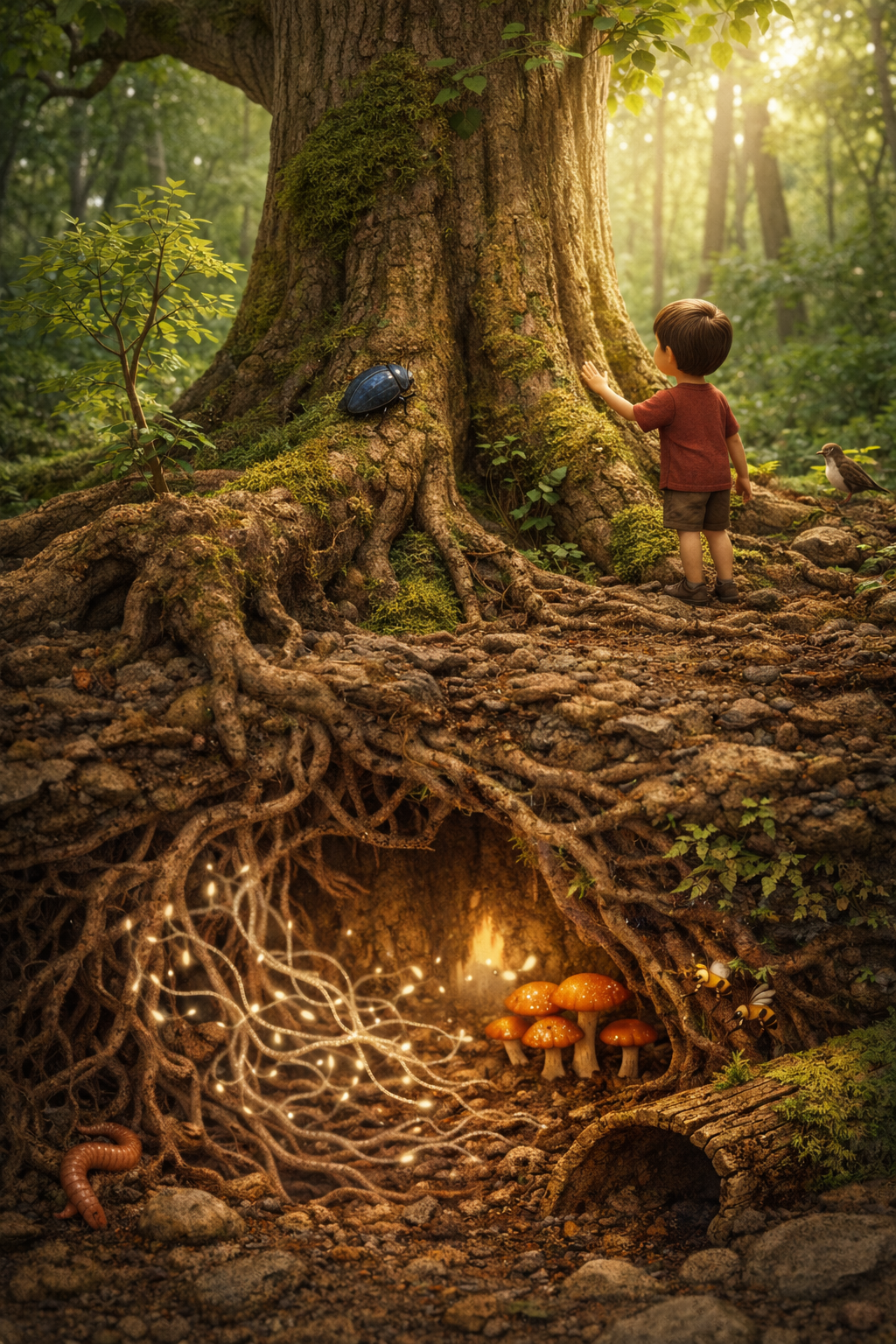
“I don’t speak like you do,” said the old tree.
“But if you stand still long enough, you will hear me.”
The forest had learned this long ago.
Birds listened by resting.
Ants listened by touching the ground.
The soil listened by holding everything together.
The tree stood near the place where a small ant once carried a seed. Its trunk was thick now, its bark lined with time. Moss grew comfortably on one side, where the sun came late. Roots stretched far beneath the forest floor, spreading like stories that refused to stay in one place.
A young sapling nearby shivered in the breeze.
“Do you ever get lonely?” the sapling asked.
The old tree smiled—not with leaves, but with patience.
“Never,” it said. “I am always in conversation.”
“With who?” the sapling asked. “I only hear birds.”
The tree let its roots sink a little deeper.
“With the soil,” it said.
“With the water,” it said.
“With the ones who came before you,” it added gently.
Below the ground, white threads of fungi glowed softly.
“He speaks too much,” the fungi hummed.
“I speak just enough,” the tree replied.
A beetle crawled along the bark. “Why don’t you move?” it asked. “The world is big.”
The tree answered slowly. “Because the world moves through me.”
Rain arrived that afternoon. Not loudly. Not all at once. Just enough to wake the roots.
“Drink slowly,” the tree whispered to the soil.
“I will,” said the earth. “If you hold me.”
“I always do.”
Water slid downward, guided by roots, shared by fungi, saved for dry days that had not yet come. Somewhere nearby, worms wriggled happily.
“This place feels safe,” said a worm.
“That is my job,” the tree said.
Days passed. Then seasons.
The sapling grew taller. Birds nested higher. Shade widened. The forest adjusted around the tree without ever announcing it.
But one morning, the roots felt something unfamiliar.
Pressure.
Heavy. Sudden. Wrong.
“Something is pressing the ground,” said a thin root.
“It hurts,” said another.
The fungi went quiet.
Above ground, the tree heard sounds it didn’t recognize—sharp, rhythmic, impatient.
“Stay calm,” the tree told its roots. “Hold what you can.”
“But the water is rushing away,” said the soil.
The tree tightened its grip.
“Then I will hold harder.”
The ground cracked nearby where roots had once woven freely. Tunnels collapsed. Ant paths vanished.
A young bird fluttered down. “Why does the ground feel angry?” it asked.
“It is not angry,” the tree said. “It is tired.”
Days later, the pressure stopped. The noise left.
But the damage remained.
“Some roots are gone,” said the fungi softly.
“I know,” the tree replied.
The sapling leaned closer. “Will we be okay?”
The tree paused before answering.
“We will adapt,” it said. “That is what living things do.”
Time passed again.
Rain returned. Slower this time. The tree guided it carefully, holding soil in place, feeding smaller plants that had nowhere else to turn.
Grass returned. Insects followed. Birds sang again, though not as loudly.
One evening, a child stood near the tree.
The child placed a hand on the bark.
“It feels warm,” the child said.
The tree felt the touch through every ring it had ever grown.
“Listen,” the tree whispered—not in words, but in feeling.
The child stood still.
Leaves rustled.
Roots drank.
The forest breathed.
“I don’t know why,” the child said softly, “but I think this tree is important.”
The tree said nothing.
It didn’t need to.
Because long before the child arrived, long before the sapling grew, long before the ant carried the seed, the tree had learned this truth:
Some voices are not meant to be loud.
Some strength is not meant to be seen.
And the forest survives not because trees stand tall—
but because they hold on.
🌱 The Invisible Circle – For You
Trees do not ask for attention.
They ask for time.
If you give them space,
they will quietly hold the world together.

Review THE INVISIBLE CIRCLE Story 2 · Forest.