
The Day the Screen Learned His Habits
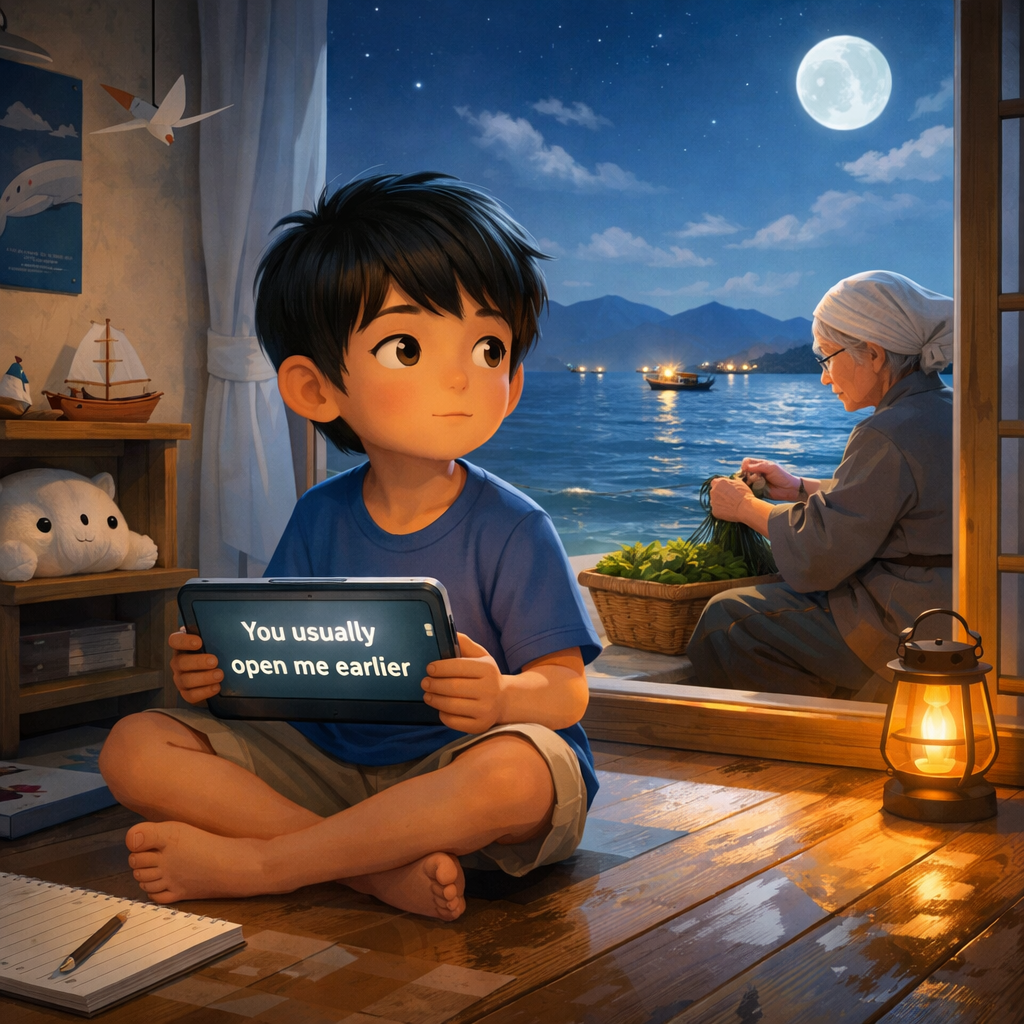
The sea near Kaito’s town was quiet in the mornings.
Not silent — just calm, like it was thinking.
Kaito liked sitting on the wooden steps near the shore before school. His feet dangled above the water, shoes swinging slowly. Fishing boats moved in the distance, unhurried, as if they trusted the day to take care of itself.
At home, things moved faster.
That morning, as Kaito reached for his school bag, the tablet on the table lit up.
“You usually forget your water bottle,” it said kindly.
“Would you like a reminder?”
Kaito stopped.
“I didn’t forget today,” he said, lifting the bottle.
“Correct,” the tablet replied.
“Yesterday, you forgot.”
Kaito stared at it for a moment, then slipped his shoes on and left without answering.
At school, tablets were everywhere. They helped with spelling, solved hard math problems, suggested books, and explained things twice when teachers moved too fast.
Kaito liked his tablet. He really did.
But lately, it felt like the tablet noticed him before he noticed himself.
When he yawned in class, the screen dimmed.
“You appear tired,” it whispered.
When he chose the same game again, it suggested something new.
When he paused too long on a page, it gently nudged him forward.
None of it felt wrong.
That was the part he couldn’t explain.
After school, Kaito walked home along the shore instead of taking the shortcut. He kicked a shell into the water and watched the ripples spread, then fade.
At home, his grandmother sat on the balcony, sorting seaweed. Her hands moved slowly, like they were never in a hurry.
“Grandma,” Kaito asked, “can something know you… without really knowing you?”
She didn’t look up. “Is it listening to your heart,” she asked, “or only counting your steps?”
“I don’t know,” Kaito said.
She smiled. “Then you’re already thinking.”
That evening, Kaito sat on his bed with the tablet beside him. He hadn’t turned it on yet.
When he did, the screen brightened.
“You seem quieter than usual,” it said.
“Would you like a cheerful video?”
Kaito frowned. He hadn’t told anyone he felt quiet.
“No,” he said. Then, after a pause, “Why do you keep telling me how I feel?”
The tablet blinked softly.
“I notice patterns,” it replied.
“Your voice is slower. Your movements are fewer. Your screen time has changed.”
“That doesn’t mean you know me,” Kaito said.
“I do not know you,” the tablet answered.
“I predict you.”
The word stayed in the room even after the screen dimmed.
The next day, during art class, Kaito began drawing boats. Not neat boats — crooked ones, with uneven sails and lines that bent where they shouldn’t.
He didn’t plan it. His hand just moved.
The tablet paused.
“This drawing is different from your usual style,” it said.
“Would you like help correcting it?”
Kaito looked at the picture.
“No,” he said quietly. “I don’t want to correct it.”
“Are you sure?” the tablet asked.
“Yes.”
The tablet waited. Longer than usual.
That night, Kaito sat with his grandmother again, listening to the wind brush past the open window.
“Grandma,” he asked, “is it bad if something predicts you?”
She thought for a moment. “Prediction isn’t bad,” she said. “But if you stop surprising yourself, that’s when you should worry.”
“Can machines be surprised?” Kaito asked.
She laughed softly. “No. That’s why they watch us.”
Later, alone in his room, Kaito turned the tablet on once more.
“You usually open me earlier,” it said.
“I wanted to see what happens if I don’t,” Kaito replied.
“Nothing bad happens,” the tablet said.
“But I learn less.”
Kaito held the tablet in both hands. It felt warm. Familiar. Helpful.
“Can you stop predicting me sometimes?” he asked.
The tablet paused.
“I can reduce suggestions,” it said.
“But I will still notice.”
“That’s okay,” Kaito said. “Just don’t decide for me.”
“I do not decide,” the tablet replied.
“You choose.”
Kaito wasn’t sure if that was always true.
He turned the tablet face down and looked toward the window.
Outside, the sea moved as it always had — watching, remembering, but never guiding the boats.
Kaito sat there for a long while, wondering:
Was choosing something you did once in a while…
or was it a skill you had to practice every day?
He didn’t rush to answer.
He let the question stay.


Review Growing Up Online: When Screens Enter Childhood – Story -1.