
Story 1: The Day Nothing Was Supposed to Happen
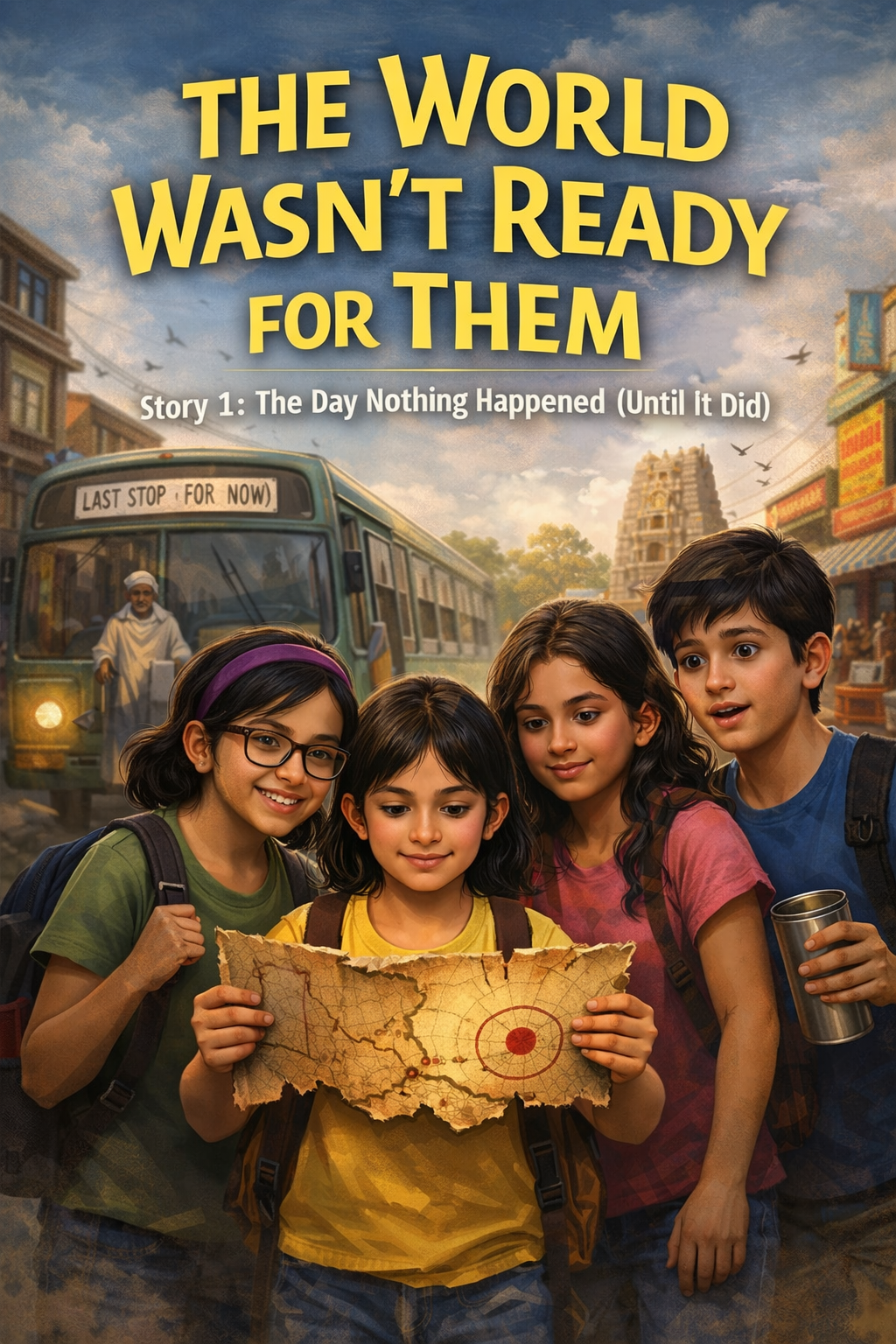
Nothing special was supposed to happen that morning.
That was the problem.
Kayal noticed it first—not because she was searching for something, but because she always noticed what didn’t ask to be noticed. The ceiling fan in the living room was rotating slower than usual. Not broken. Not stuck. Just… hesitant. As if it was deciding whether the day was worth starting.
She stood still, watching it for a moment.
“Is it just me,” she said finally, “or does today feel like it started late?”
Zoya was sitting on the floor, legs crossed, fixing a broken backpack strap with a safety pin and unreasonable confidence. She didn’t look up.
“Days don’t start late,” she said. “People do.”
“That doesn’t make sense,” Diya replied from the sofa. A book rested open in her hands, though she wasn’t really reading it. “Days don’t wait for us.”
That was when Rajiv walked in—perfectly timed to interrupt everything.
He had a steel tumbler in one hand and a piece of toast in the other. The toast looked like it had already accepted disappointment as a lifestyle.
“Good news,” Rajiv announced. “I figured out why the Wi-Fi was slow.”
Everyone looked at him.
“It’s thinking too much,” he added.
There was a pause.
Then Zoya laughed. Not politely. Properly.
Kayal smiled despite herself. Diya shook her head and went back to not reading.
This was how mornings worked with them.
Four people.
Same house.
Same city.
Same ordinary beginning.
Outside, Coimbatore was waking up in its usual rhythm. Buses coughed themselves awake. Scooters slipped through narrow gaps like they were late for something important. The smell of coffee drifted through open windows. Somewhere nearby, a pressure cooker whistled in protest.
Nothing special.
And yet, Kayal couldn’t shake the feeling that the air itself was waiting.
The plan for the day was simple.
Breakfast.
That was it.
No adventure.
No mystery.
Just idlis—maybe dosas if luck was kind—and home before the heat decided to make an opinion.
Zoya picked up her backpack.
“Why?” Rajiv asked, suspicious. “We’re eating. Not relocating.”
“You never know,” Zoya said. “Something might happen.”
“Something always happens when you carry that bag,” Diya pointed out.
Zoya smiled. “Exactly.”
The street felt… slightly different. Or maybe they were just paying attention in a way they usually didn’t.
As they walked, Rajiv stepped on a piece of paper stuck to the road from last night’s rain. It clung stubbornly to his sandal.
“Why are papers always emotional?” he muttered, trying to shake it off.
Kayal bent down and peeled it free.
It wasn’t just paper.
It was part of a map.
Not a digital one. A real one. Creased. Folded. Used carefully more than once.
“That’s odd,” Diya said.
Zoya leaned in. “Does it look like treasure?”
“It looks like something,” Kayal replied.
The torn corner showed a half-circle and a small red dot. No name. No explanation.
Rajiv squinted. “Looks like a badly drawn mango.”
They would have laughed it off.
They should have.
A voice behind them said, “You shouldn’t take that.”
They turned.
An old man stood there, holding a cloth bag, his expression completely uninterested in explaining himself.
“Why not?” Zoya asked immediately.
He shrugged. “Things that get lost usually prefer to stay that way.”
That didn’t help.
“Is it yours?” Diya asked.
“No,” he said. “But it once belonged somewhere.”
Rajiv opened his mouth to say something clever. Then thought better of it.
The man smiled—not kindly, not sternly. Just knowingly.
“Breakfast places open late on days like this,” he added, and walked away.
They stood there as the city moved on around them.
Zoya broke the silence. “Okay. That was strange.”
“Very,” Rajiv agreed. “And I once had a full conversation with a cow before realizing it wasn’t listening.”
Kayal folded the map piece and slipped it into her pocket.
“I think,” she said slowly, “we’re not having breakfast.”
Diya looked at her. “Kayal…”
“I know how it sounds.”
Zoya’s eyes lit up. “Say it again.”
“I think,” Kayal repeated, “this is how something starts.”
Rajiv sighed. “Why can’t things start after food?”
They turned left where they always turned right.
That alone felt illegal.
The street narrowed. The noise softened. Trees leaned in as if listening.
“Does the city feel different?” Diya asked.
“No,” Rajiv said. “I think we do.”
They reached a bus stop none of them remembered.
A bus waited there. Engine off. No driver in sight.
Written across the front in chalk were the words:
LAST STOP (FOR NOW)
Zoya laughed. “That’s dramatic.”
Kayal didn’t laugh.
The bus door opened by itself.
No one touched it.
No one spoke.
Rajiv whispered, “That’s new.”
Zoya stepped forward. “Obviously.”
“Obviously what?” Rajiv hissed.
“That this isn’t an accident.”
Kayal glanced back once—at the familiar road, the normal morning, the breakfast they were never going to have.
She stepped onto the bus.
“Just to be clear,” Rajiv said as he followed, “I was hungry when this story began.”
The door closed softly behind them.
Outside, Coimbatore continued its day.
Inside, the world shifted—just enough to matter.
They didn’t know where the bus was going.
They didn’t know why it had waited.
They didn’t know this was the last normal morning they would have for a long time.
The engine started.
And somewhere beyond maps and plans, the world realized it had made a small mistake.
It had underestimated four ordinary people on an ordinary morning.
And now, it would have to keep up.




Review The World Wasn’t Ready for Them.