
Story No. 5: Old Wisdom, New Machines
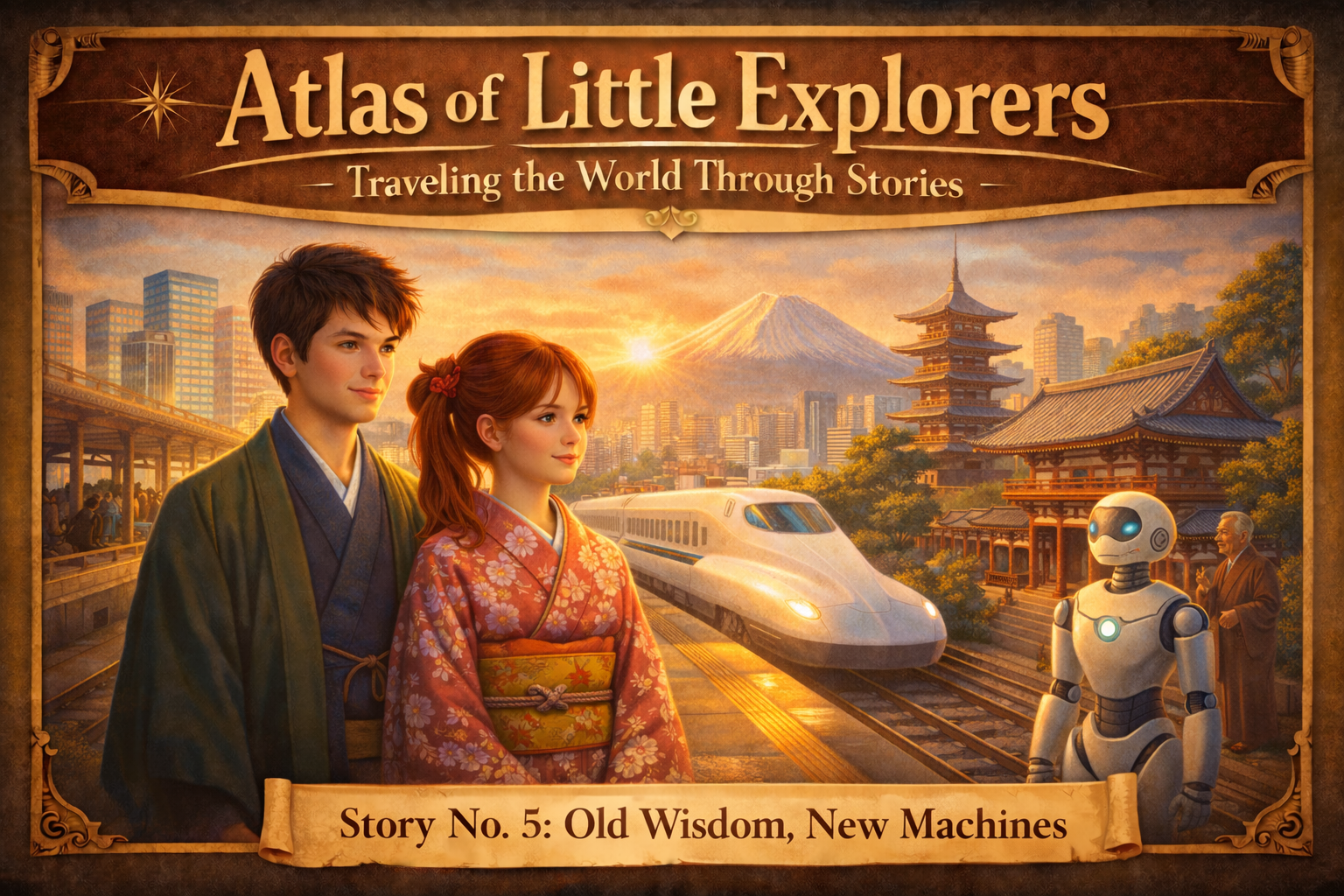
The sound came first.
A soft hum.
Then a rush of air.
Sid and Sam stood on a platform so clean it almost reflected the sky. Yellow lines ran neatly along the edge. People waited quietly, standing exactly where the signs suggested.
No one rushed.
No one shouted.
Sam leaned closer to Sid. “It feels like the train is already here… even before it arrives.”
Sid smiled. “That’s planning.”
A sleek train slid into the station, smooth and silent, like it belonged to the rails.
“This is fast, isn’t it?” Sam asked.
“Very,” Sid said. “But watch how people treat it.”
They boarded. Shoes stayed clear of seats. Bags were held close. Voices dropped to whispers.
The doors closed.
The train moved.
The city outside blurred into lines of light and shadow.
Fields appeared. Rivers curved gently. Houses passed like careful brushstrokes. The speed was thrilling—but never wild.
Sam held the window edge. “It’s like flying… but close to the ground.”
An elderly man across from them smiled. “Speed is useful,” he said. “Only when it knows where to go.”
Sid nodded. “That sounds like something you’ve thought about.”
The man chuckled. “I have lived long enough to see ink become screens.”
Later that day, they walked into a quiet museum filled with old tools.
Brushes stained with ink.
Wooden blocks carved with symbols.
Delicate paper, folded and refolded.
“This is how stories were written,” the guide explained. “By hand. Slowly.”
Sam tried holding a brush. Her hand trembled slightly.
“It’s hard,” she said.
“Yes,” the guide replied kindly. “That’s why people respected words.”
Sid noticed something on the wall—a timeline.
Brush → Printing → Typewriter → Computer → Robot arms.
“They didn’t erase the past,” he said. “They built on it.”
The guide smiled. “Exactly.”
That evening, the contrast grew even sharper.
They visited a technology center where machines moved with precise grace. Robots sorted, assembled, and tested. Screens showed simulations of cities powered by clean energy.
Sam’s eyes widened. “This feels like the future.”
A young engineer overheard her. “It is,” he said. “But it listens to the past.”
He pointed to a small shrine in the corner of the building—simple, quiet, untouched.
“We bow before work,” he explained. “To remember responsibility.”
Sam blinked. “Even here?”
Especially here,” he replied.
As they walked back, city lights reflected on calm water.
Old wooden houses stood beside glass buildings. Temples rested in the shadows of towers. A grandmother walked past a group of teenagers scrolling on their phones—and they stepped aside to let her pass.
Sid watched closely. “They move fast,” he said, “but they still look back.”
Sam thought for a moment. “Maybe that’s how tomorrow stays beautiful.”
That night, the map opened again.
Japan glowed differently this time—not with color or fabric, but with lines of connection.
Past to present.
Present to future.
Ink to code.
Silence to speed.
Sid folded the map carefully. “Progress doesn’t mean forgetting.”
Sam smiled. “It means remembering better.”
The compass needle turned—not sharply, not suddenly.
Just enough to say:
There is still more to see.
🌍✨
What kids quietly learn from this story:
- Technology works best when guided by values
- Speed is powerful when used responsibly
- The past is a foundation, not an obstacle
- Innovation and respect can live together
Continue to Story 6 / Back to Story 4


Review Atlas of Little Explorers: Traveling the World Through Stories – Story 5 – Japan.