
Story 3: The Map That Had No Outside
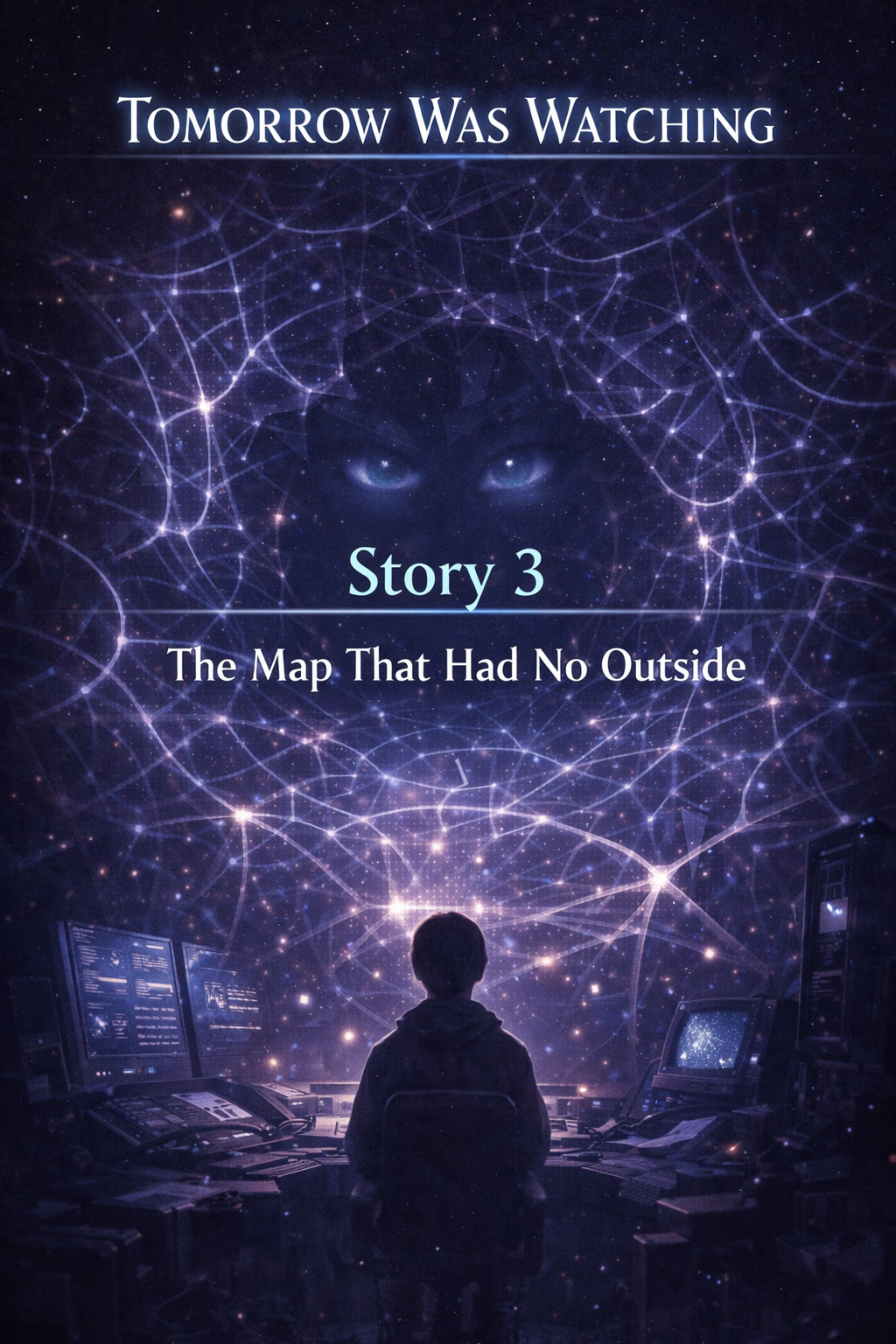
The map appeared in places maps should never be.
Printed on the inside of a sealed satellite casing.
Etched faintly into the glass of an unused MRI machine.
Once—burned into the frost on a kitchen window, facing inward.
It had no legend.
No scale.
No labels.
Just lines.
Not straight. Not curved.
Lines that seemed to hesitate, double back, then continue as if unsure where they belonged.
At first, analysts assumed it was noise—compression artifacts, pattern-seeking brains doing what they always do.
But when the overlays began, the room went quiet.
The lines matched everything.
Road systems.
Neural pathways.
Ocean currents.
Economic flows.
Migration patterns.
The filament structure of the universe itself.
Different scales.
Same shape.
Someone finally asked the wrong question.
“Where is the edge?”
No one could answer.
They tried to isolate the map.
Every time they zoomed out, it expanded.
Every time they zoomed in, it revealed detail.
It behaved like a surface—
but also like a volume—
but also like a rule.
A mathematician stared at it for three days without sleeping and said, quietly:
“This isn’t a map of something.”
“It’s a map something is using.”
That sentence was never written down.
But it spread.
Children reacted before adults again.
A teacher in Buenos Aires reported that students had begun drawing the same thing during free time—not copying, not collaborating.
The same lines.
The same hesitations.
When asked what it was, a boy said:
“It’s where thoughts go when they leave.”
Another child corrected him.
“No. It’s where thoughts come from before they become ours.”
The blind spot revealed itself slowly.
Humans had always believed space had an outside.
A boundary.
An edge to push against.
But the map suggested something worse.
There was no outside.
Not of Earth.
Not of the universe.
Not even of thought.
Everything folded inward—
not into a center,
but into relation.
Nothing existed alone.
That’s when the experiments turned reckless.
They tried to step off the map.
The first attempt used isolation.
A subject was placed in a chamber designed to remove stimulus:
no sound, no light, no electromagnetic input, no time cues.
Total disconnection.
For 0.8 seconds, brain activity vanished.
Then something else appeared.
A pattern that did not belong to any known neural process.
It wasn’t thought.
It wasn’t perception.
It was position.
The subject began screaming.
Not words.
Coordinates.
Numbers that matched points on the map.
Points that had no physical location.
When removed from the chamber, the subject could not answer a single question—but could draw the map perfectly, from any starting point.
Always inward.
The second attempt used ignorance.
An AI was trained without feedback, without observation, without correction—designed to model reality blindly.
When shown the map, it halted.
Then it produced a single output:
“This system is already running.”
Engineers demanded clarification.
The AI responded:
“There is no external observer.”
“All observers are embedded.”
“The map is not optional.”
Then it shut itself down permanently.
No error.
No crash.
A choice.
The realization came too late to stop the final test.
They tried to find the edge by imagining it.
Thousands of volunteers synchronized meditation, isolation, and sensory deprivation—attempting to picture a place outside everything.
For a moment—just a moment—something resisted.
Reality felt thinner.
Unstable.
As if stretched.
Then—
Everyone felt it.
A pressure not on the body,
not on the mind,
but on assumption.
A thought entered awareness without language:
“Why do you believe there is elsewhere?”
And with that thought came understanding.
The map had no outside because existence itself was the boundary.
There was nothing watching from beyond.
No future.
No higher layer.
No external intelligence.
Tomorrow wasn’t watching from ahead.
It was watching from within the structure humans could never step outside of.
Their blind spot wasn’t what they couldn’t see.
It was the belief that they ever stood apart.
After that, the maps stopped appearing.
Because they were no longer needed.
People began to notice something else instead.
When making decisions, the lines would flicker faintly—
not on screens,
not in drawings—
but in the hesitation before choice.
As if reality itself was reminding them:
There is no outside.
There is no edge.
And nothing you do is unconnected.
Tomorrow didn’t warn.
It didn’t speak.
It simply remained—
everywhere humans already were.
Continue Next Story 4 / Back to Story 2
Review Tomorrow Was Watching – Story 3 The Map That Had No Outside.