
Story 7 — The News That Ran Faster Than the Wind
In the village where Mateo lived, the wind arrived before the rain.
It rushed through the fields, bent the tall grass, rattled the tin roofs, and then disappeared, leaving everything quiet again. Mateo liked watching it from his window, guessing when the rain would finally follow.
Mateo was eleven. He lived in southern Spain, where afternoons were warm and people talked loudly even when they were calm.
News traveled fast there.
Sometimes faster than the wind.
One afternoon, Mateo was doing his homework when his cousin Lucia burst into the room.
“Did you hear?” she asked, eyes wide.
“Hear what?” Mateo said, looking up.
“There’s a dangerous animal near the school,” Lucia said. “People are saying it escaped from somewhere.”
Mateo frowned. “What animal?”
“I don’t know,” Lucia said. “But everyone is sharing it.”
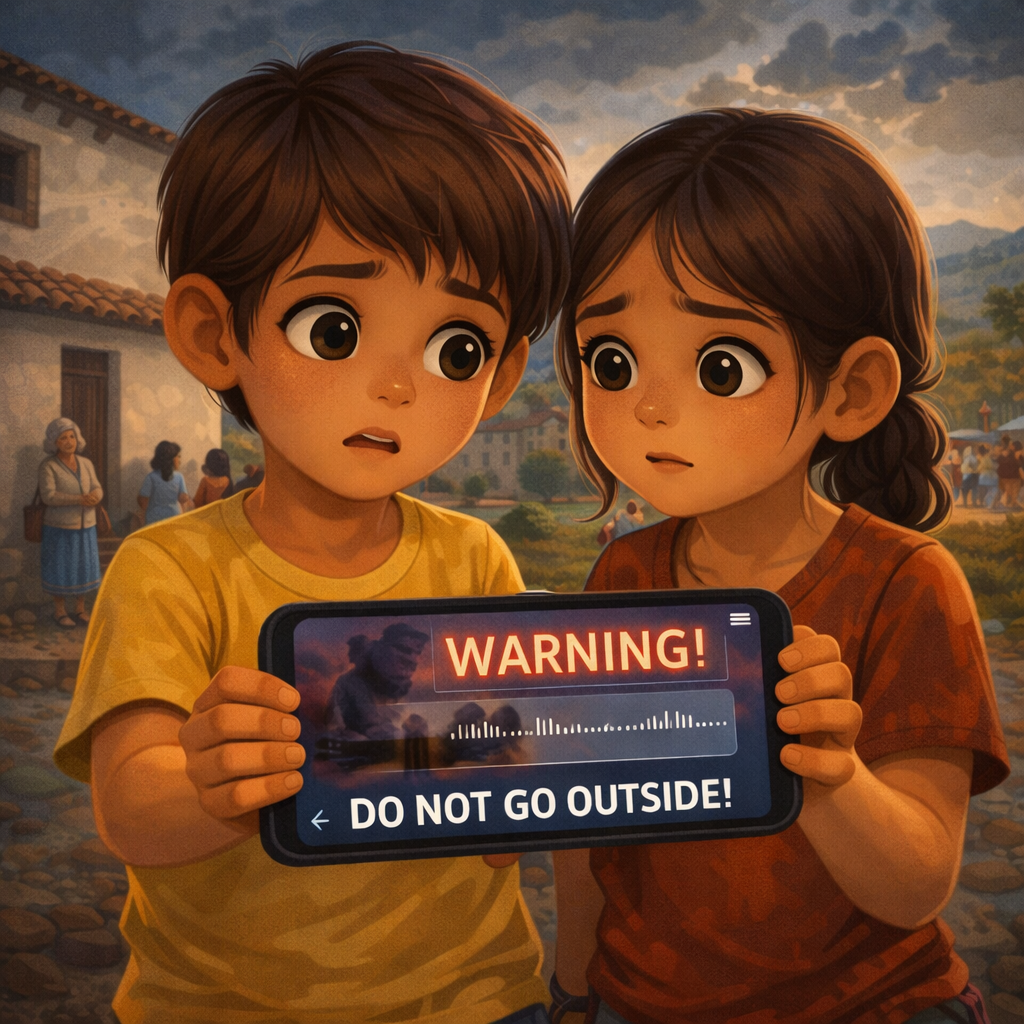
She held up her phone.
The screen showed a blurry picture and big letters:
WARNING! DO NOT GO OUTSIDE!
Mateo felt a small knot form in his stomach.
Within minutes, messages filled the family group chat.
- Is it true?
- My neighbor saw something!
- Keep the children inside!
Mateo’s grandmother crossed herself quietly. His younger brother clutched Mateo’s arm.
“What if it comes here?” his brother whispered.
Mateo didn’t answer. He didn’t know what to say.
That evening, the village felt different.
Doors closed earlier.
Voices lowered.
Children stayed indoors.
Mateo refreshed the screen again and again.
New messages kept appearing.
Some showed pictures from faraway places.
Some showed drawings.
Some showed nothing at all.
But every message sounded sure.
At dinner, Mateo asked his father, “Is it real?”
His father took a deep breath. “I don’t know yet.”
“But everyone says it is,” Mateo said.
“That doesn’t mean it is,” his father replied gently.
Mateo wasn’t sure he believed him.
Later that night, Mateo couldn’t sleep. He imagined shadows moving outside his window.
He picked up the tablet and searched:
dangerous animal village news
Hundreds of results appeared.
Different animals.
Different places.
Different years.
None mentioned his village.
Mateo felt confused.
The next morning, the school group chat buzzed early.
School closed today. Stay safe.
Mateo’s heart raced.
Then, another message arrived — this time from the local council.
No danger reported. Please remain calm.
Mateo stared at the screen.
Which one was true?
At breakfast, his grandmother poured coffee slowly, like she always did.
“Paati,” Mateo asked, “how do you know which news to believe?”
She smiled sadly. “When I was young, news walked to us,” she said. “Now it runs.”
“Is running bad?” Mateo asked.
“No,” she said. “But running doesn’t look around.”
By noon, another message spread.
Animal sighting was false. Old image reused.
Slowly, doors opened again.
Children stepped outside.
Voices returned to normal.
The wind moved through the village like nothing had happened.
That afternoon, Mateo met his friend Diego near the field.
“My mother was very scared,” Diego said.
“So was my brother,” Mateo replied.
“Why would someone send fake news?” Diego asked.
Mateo thought about it.
“Maybe they wanted attention,” he said. “Maybe they didn’t check.”
Diego kicked a stone. “It felt real.”
Mateo nodded. “Fear feels real fast.”
That evening, Mateo sat with his father on the steps outside their house.
“Papa,” he asked, “why did the scary message spread faster than the calm one?”
His father thought for a moment. “Fear runs,” he said. “Truth walks.”
“Isn’t that unfair?” Mateo asked.
“Yes,” his father said. “That’s why we have to help truth.”
“How?” Mateo asked.
“By slowing down,” his father said. “By checking. By not sharing right away.”
The next week, a different message appeared.
This one warned about a storm.
Mateo didn’t forward it.
He checked the weather site.
He listened to the radio.
He waited.
The storm came — gently, just rain.
Mateo smiled to himself.
That night, Mateo wrote something on a piece of paper and stuck it near his desk:
If news makes my heart race,
I will pause before I pass it on.
He didn’t know if everyone would do the same.
But he knew he could.
As the wind returned that evening, Mateo watched it bend the grass again.
He realized something important:
Not every fast thing is true.
Not every loud thing is real.
Sometimes, the quiet answers take longer to arrive.
And that was okay.
Mateo closed his window and turned back to his homework, wondering:
In a world where news runs faster every day…
will children learn to slow it down?
He didn’t know.
But tomorrow, if a message arrived shouting for attention,
he knew what he would do.
He would stop.
He would look.
And he would let the truth catch up.



Review Growing Up Online: When Screens Enter Childhood Story 7.