
Story 9 — The Smallest Helpers
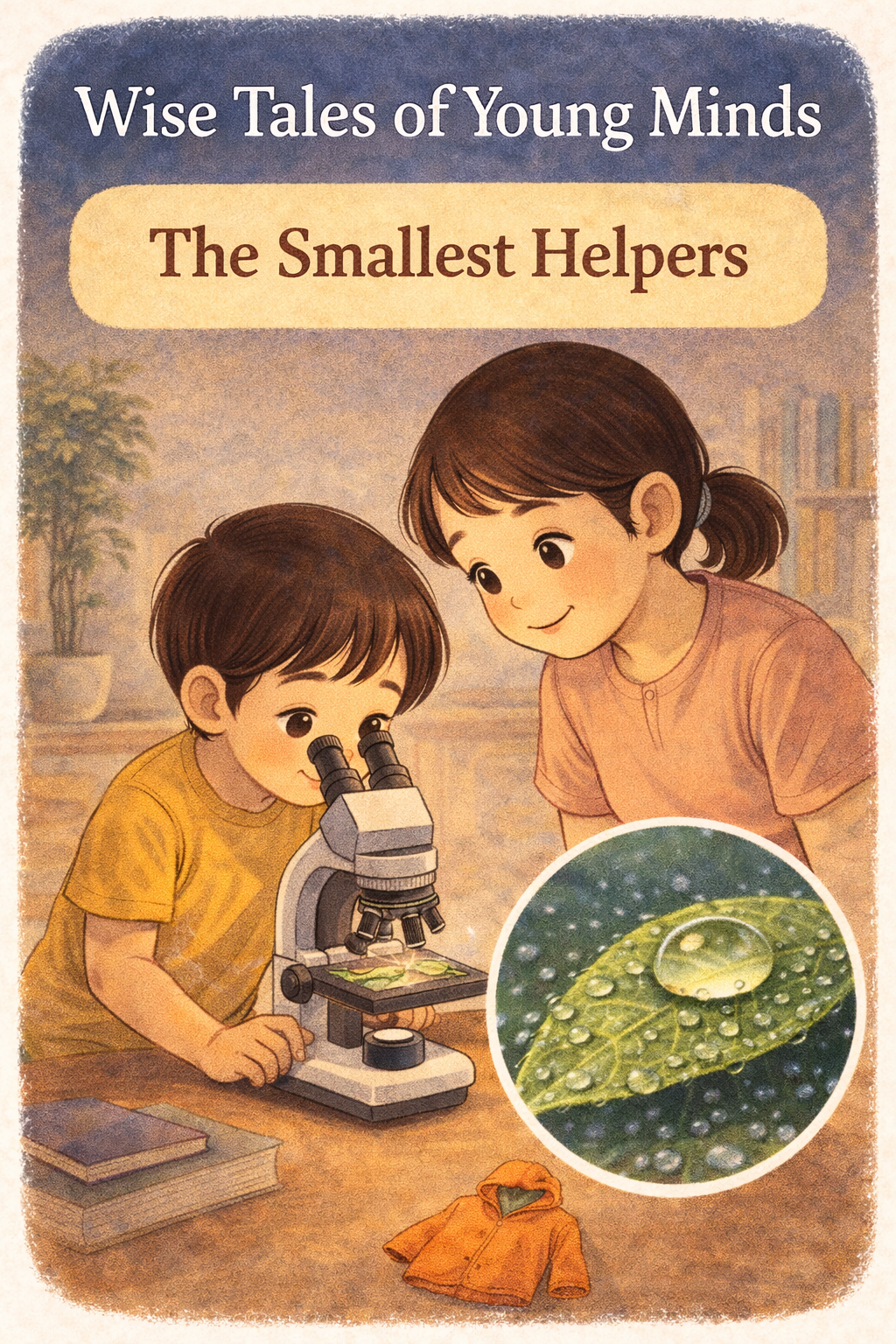
The rain had stopped, but the leaves were still wet.
Milo crouched near the garden fence, staring at a leaf that shone like glass. Tiny drops clung to it, round and perfect.
He tilted his head.
“The leaf isn’t drinking the water,” he said.
His aunt knelt beside him. “What do you mean?”
“It’s clean,” Milo said. “But the water doesn’t spread. It just rolls.”
He touched the leaf gently. The water slid away and fell to the ground.
🧩 A thinking pause
“Why doesn’t it stick?” Milo asked.
“Everything else gets wet.”
His aunt smiled. “Let’s look closer.”
Inside, she placed a small leaf under a simple microscope. Milo leaned forward, his eye wide.
The leaf wasn’t smooth.
It was full of tiny bumps — smaller than grains of sand. Smaller than dust.
“So many hills,” Milo whispered.
“Too small to see without help,” his aunt said. “But they matter.”
She placed a piece of cloth under the microscope next. It looked flat. Plain.
Then she showed him a special jacket.
Under the microscope, its surface looked different — like tiny hooks and patterns Milo had never seen before.
🧩 Another thinking pause
“These look like they’re doing something,” Milo said.
“They are,” his aunt replied. “They help water roll away. Dirt too.”
Milo thought about the leaf again.
“So the leaf stays clean,” he said, “because of things too small to see.”
“Yes,” she said. “Tiny helpers.”
That evening, Milo wore his rain jacket outside. The water slid off just like it had on the leaf.
He laughed.
Inside his room later, Milo looked at his hands.
They looked normal.
But now he wondered.
“How many tiny helpers are working,” he asked softly, “without us knowing?”
Before sleep, Milo imagined the smallest world — not loud, not busy — just quietly doing its job.
Holding.
Protecting.
Helping.
He smiled.
Some of the most important work in the world, he realized, is done by things so small…
they don’t even ask to be seen.
🌱 What this story gently weaves together
- Emotional intelligence: wonder, humility, curiosity
- Life intelligence: respect for unseen effort
- Scientific curiosity: surface structure, water behavior
- Nanotechnology awareness: tiny structures create big effects
- Reasoning skills: observation, scale comparison
🧩 Puzzle types used
- Scale thinking (seen vs unseen)
- Cause & effect (surface → behavior)
Review Wise Tales of Young Minds Story 9.