
The Village That Built Too Close

“We’ll be safe here,” said the village.
The river flowed nearby, calm and wide after learning how to bend. Her curves held reflections of sky and willow, fish resting in the slower water. To the villagers, she looked friendly—useful even.
“Close water means easy living,” said one builder, setting a stone at the edge.
“And flat land,” said another. “Perfect.”
The river listened.
She had learned to slow, to share, to give space. But space only works when both sides remember it exists.
Upstream, the mountain felt uneasy.
“Water,” she murmured, “leave yourself room.”
“I have,” the river replied. “I hope they will too.”
The first houses rose quickly. Paths straightened. The grass along the bank was pressed flat by feet and carts.
A willow leaned closer. “They’re standing where floods used to rest.”
“They don’t know,” said the river gently.
Spring came.
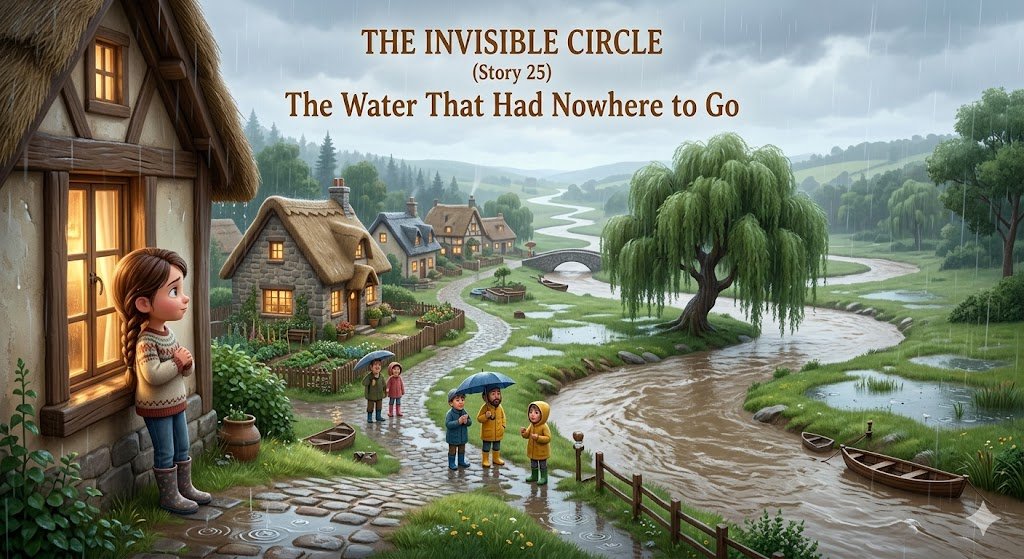
Rain arrived—not angry, not wild—just steady. The river swelled a little, then a little more. She searched for her old places to spread and slow.
They were gone.
“Excuse me,” the river whispered to the stones of a new wall. “I need this space.”
The wall did not move.
Water climbed.
In the village, a child watched the river lick the steps of a house.
“It’s closer today,” the child said.
“Don’t worry,” said an elder. “It’s never crossed this line.”
But lines drawn by people are not the same as lines remembered by land.
The river tried to bend, but there was nowhere to go.
“I’m sorry,” she said, as water slipped into the lowest paths.
Mud followed. Then quiet panic.
“We didn’t expect this,” the villagers said.
The river did not argue. She carried what she could gently. She rested where she could. She waited for the rain to finish.
When it did, the water receded.
The village stood—changed, but standing.
That evening, the child walked along the edge where the grass used to be.
“The river came here before,” the child said softly, pointing to a faint mark on a stone.
“Yes,” said the willow. “Long before.”
The child sat and listened to the water.
“You didn’t mean to hurt us,” the child said.
“No,” the river replied. “I meant to be myself.”
The villagers gathered.
“We built too close,” one said.
“We forgot the bends,” said another.
They moved slowly, thoughtfully. Walls were shifted back. Low places were left open again. Grass returned. Willows were planted where roots could hold.
The river felt relief.
“Thank you,” she said.
“We’re learning,” the village replied.
Upstream, the mountain relaxed her shoulders.
Downstream, fields drank gently.
Between them, the river flowed—not controlled, not feared—just understood.
The child skipped a stone across the water’s widest bend.
“It’s better like this,” the child smiled.
“Yes,” the river agreed. “For all of us.”
🌱 The Invisible Circle – For You
Living close to nature means listening to where it needs space.
When we give room, balance returns.
🔗 Soft Bridge to the Next Story
Beyond the village lights, where night insects gather and fields breathe again,
a farmer was learning to work with the land—not against it.
Review THE INVISIBLE CIRCLE Story 17 · Valley & People.