




Story 2: The Ship That Carried More Than Goods
When the new boy joined the class, everyone noticed his accent before his name.
He spoke slowly, carefully, as if each word needed permission to come out.
His clothes were neat but unfamiliar. His lunch smelled different.
Some children laughed.
Some avoided him.
Milan noticed something else.
The new boy always shared.
When Milan forgot his pencil, one appeared on his desk.
When someone dropped their water bottle, the new boy picked it up quietly.
He never explained himself. He just did things.
One afternoon, the teacher announced a group project.
“You’ll work in pairs,” she said. “Choose carefully.”
No one chose the new boy.
Milan hesitated. He didn’t dislike him — he just didn’t know him.
But something tugged at him, like a small wave against the shore.
“I’ll work with him,” Milan said.
The boy smiled with relief. “Thank you. I’m Ilan.”
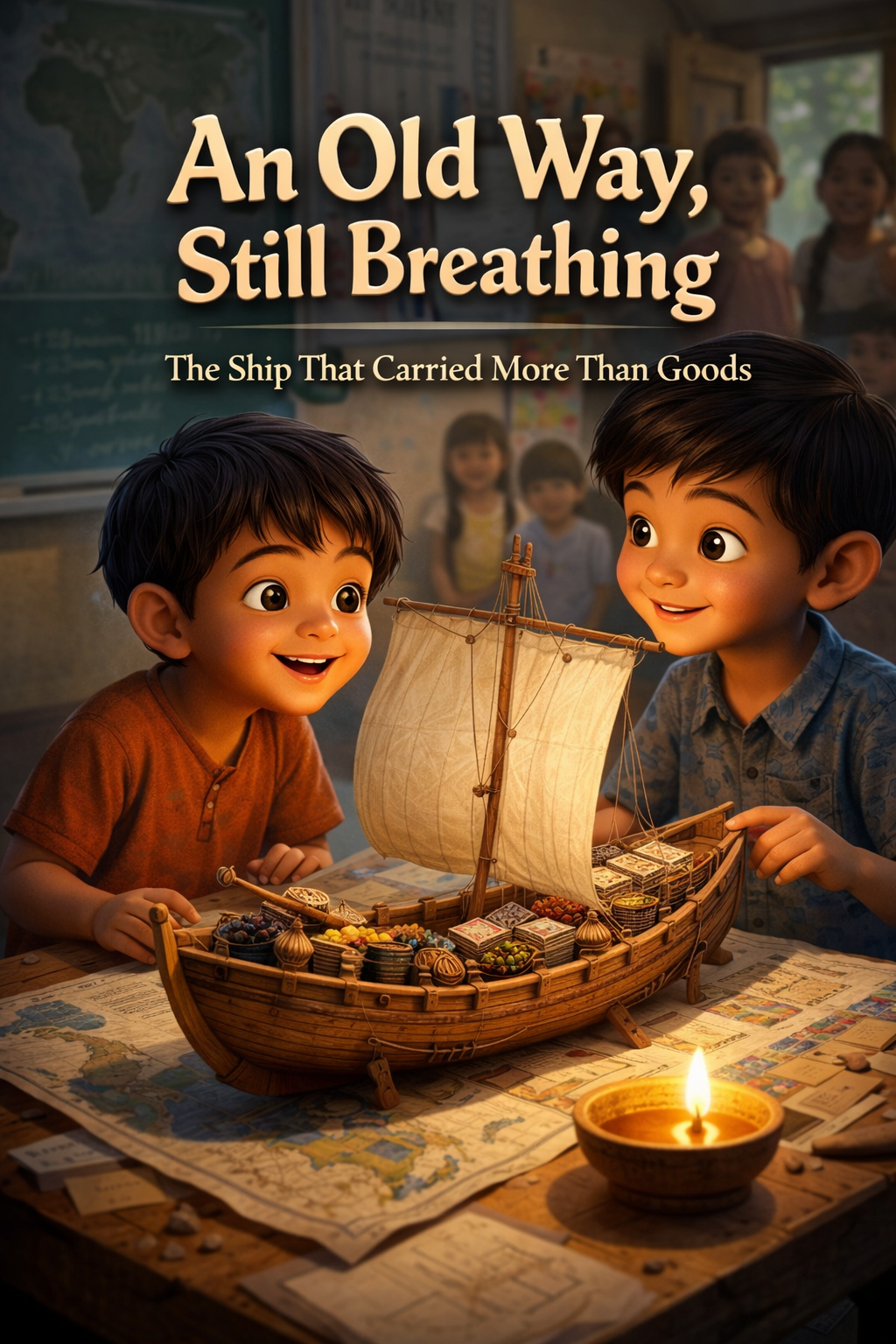
They decided to build a model of an ancient ship — not a warship, not a racing boat, but a simple trading vessel.
“At my home,” Ilan said, “my grandfather tells stories about ships.”
Milan raised an eyebrow. “Like pirates?”
Ilan shook his head. “No. Like people.”
That evening, Milan visited Ilan’s house to work on the project.
Ilan’s grandfather was sitting near the window, repairing a small wooden toy boat.
He looked up and smiled.
“You’re building a ship?” he asked.
“Yes,” Milan said. “For school.”
The old man nodded. “Then remember — a good ship is not about speed. It’s about balance.”
Balance.
The word stayed with Milan.
As they worked, Ilan explained how their model ship would carry spices, cloth, salt, and stories.
“Stories?” Milan asked.
“When people traveled, they didn’t only exchange goods,” Ilan said.
“They exchanged ideas. Songs. Words. Ways of cooking.”
Milan paused. He had never thought of trade like that.
At school the next day, someone scoffed.
“So your ship just… shares things?”
Milan felt a sudden heat rise in his chest. He wanted to argue.
But Ilan spoke calmly.
“Yes,” he said. “Because if you return with profit but leave harm behind, you haven’t really gained anything.”
The room grew quiet.
On presentation day, their ship stood among glittering projects with flashing lights and spinning parts.
Their model was plain. Wooden. Simple.
But when Milan explained how the ship stopped at different shores — learning languages, respecting customs, trading fairly — something shifted.
A judge asked, “Who owned the sea in your story?”
Milan answered without thinking.
“No one. That’s why everyone could meet.”
After the presentation, something unexpected happened.
A few classmates came up to Ilan.
“Your lunch smells good,” one said awkwardly.
“What is it?”
Ilan smiled. “Want to try?”
That day, the lunch table felt different.
At home, Milan told his grandmother about the ship.
She listened, then said, “Long ago, people understood that travel was not about taking more. It was about returning wiser.”
Milan looked at his project notes.
The ship didn’t win first place.
But later, when new students joined the class, something had changed.
No one stood alone for long.
And Milan realized something important:
The strongest journeys were not the ones that crossed oceans —
but the ones that crossed fear.
🌿
Some ways of living travel farther than ships.
They arrive quietly — and stay.



Review An Old Way, Still Breathing Story 2.