
Story 3: The Village That Didn’t Ask Who They Were
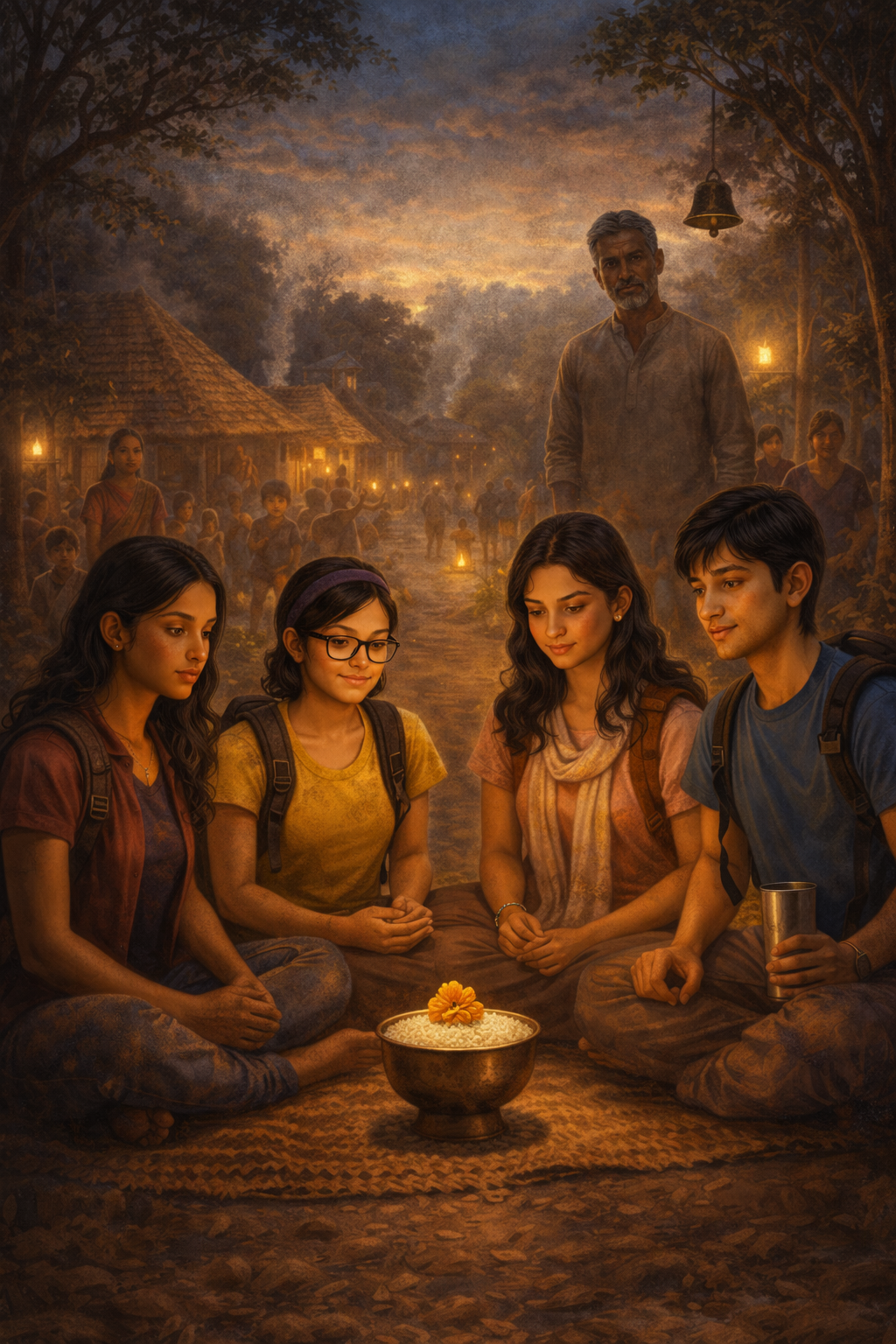
The village did not react the way they expected.
That was the first thing Kayal noticed.
No one stared.
No one whispered.
No one looked alarmed.
People walked past them carrying baskets, water pots, bundles of firewood. Children ran barefoot along the path, laughing, stopping only briefly to glance at the four strangers standing at the edge of the village.
Then they went back to their games.
Zoya blinked. “Okay… either we’re invisible, or this place has very relaxed stranger policies.”
Rajiv adjusted his backpack strap. “I don’t like either option.”
Diya watched an elderly woman sweep the ground in front of her house with slow, practiced movements. The woman looked up, met Diya’s eyes, and smiled—warmly, like she had been expecting her.
Not surprised.
Not curious.
Just… welcoming.
Diya felt something settle in her chest. “They’re not ignoring us.”
“Then what are they doing?” Zoya asked.
Kayal answered quietly. “They’re letting us arrive.”
A narrow path ran through the center of the village. Clay houses lined either side, their walls painted in faded earth colors. Smoke curled upward from cooking fires, carrying the smell of rice, spices, and something unfamiliar but comforting.
Rajiv leaned closer to Kayal. “No phones. No wires. No signboards.”
“And no clocks,” Kayal added.
Zoya laughed softly. “My kind of place.”
A boy about ten years old stood near a tree, watching them with open curiosity. He didn’t look afraid. He didn’t look impressed.
He looked like he was waiting for a question.
Zoya took the hint. “Hi.”
The boy smiled. “You came by the bus.”
Rajiv froze. “You saw that?”
The boy shook his head. “No. But people who come here always do.”
Kayal stepped forward. “Where are we?”
The boy tilted his head, thinking. “You’re here.”
Zoya grinned. “That’s not an answer.”
The boy shrugged. “It usually is.”
Before Rajiv could respond, a voice behind them said, “Let them breathe first.”
They turned.
A man stood there, tall and lean, with silver beginning to show at his temples. His clothes were simple, his posture relaxed, his eyes sharp in a way that suggested he noticed things long before others did.
“I’m Arun,” he said. “You look like you’ve traveled without planning to.”
Rajiv exhaled. “You have no idea.”
Arun smiled. “I have some idea.”
They were led to a small open space near the center of the village. Mats were spread under a large tree whose branches stretched wide, offering shade without asking for attention.
A woman brought water in clay cups. Cool. Clean. Perfect.
Zoya drank first. “Best water I’ve ever had.”
Rajiv nodded. “Either that, or I’m just very relieved to still exist.”
No one laughed loudly. But several people smiled.
Kayal noticed how the villagers sat—not around them, not facing them directly, but nearby. Present without pressure.
Diya leaned toward Arun. “Do people often arrive like this?”
Arun considered the question. “Often enough that it no longer feels strange.”
Zoya raised an eyebrow. “And what do they usually do?”
“They stay,” Arun said. “Until they don’t need to.”
Rajiv frowned. “Need to what?”
Arun looked at him. “Leave.”
That answer landed heavily.
Kayal reached into her pocket and took out the torn map. She unfolded it carefully.
The red dot was no longer alone.
Thin lines had appeared around it, faint but unmistakable.
Diya inhaled sharply. “That wasn’t there before.”
Arun’s eyes flicked to the map. For just a second, his calm shifted.
“Ah,” he said softly. “So it has started moving.”
Zoya leaned in. “Maps aren’t supposed to move.”
“Neither are people,” Arun replied. “Yet here you are.”
Rajiv crossed his arms. “Okay. I’m officially uncomfortable.”
Arun met his gaze. “Good. That means you’re paying attention.”
As evening approached, the village changed its rhythm.
Fires were lit. Lamps glowed softly. The air cooled. A bell rang—not loud, not urgent—just enough to mark the moment.
People gathered again near the tree.
Diya watched the way everyone moved together, not rushed, not slow. Balanced.
“What are they doing?” she whispered.
Kayal shook her head. “I don’t think it’s for us.”
A young girl stepped forward and placed a small bowl in front of the four of them. Inside were grains of rice and a single flower.
“For grounding,” the girl said, as if explaining the most ordinary thing in the world.
Rajiv stared at it. “Grounding from what?”
The girl smiled. “From everything you haven’t realized yet.”
Zoya laughed. “I like her.”
Arun stood beside Kayal. “The village doesn’t ask where you’re from,” he said quietly. “Or why you’re here.”
Kayal looked at him. “Why not?”
“Because those questions belong to before,” Arun replied. “This place deals with what comes after.”
The bell rang again.
The villagers fell silent.
Even the wind seemed to pause.
Kayal felt the same shift she had felt that morning in her living room. That subtle sense that the world had leaned slightly to one side.
Only now, she understood it wasn’t the world.
It was her.
Zoya whispered, “I think we just crossed something.”
Rajiv nodded. “Yeah. And I don’t think there’s a return ticket.”
Diya smiled softly. “Maybe there isn’t supposed to be.”
Arun looked at the four of them—not as guests, not as strangers.
As participants.
“Rest tonight,” he said. “Tomorrow, the village will ask you something.”
“What?” Zoya asked.
Arun’s smile returned. Slow. Knowing.
“It will ask,” he said,
“what you are willing to carry forward.”
The lamps flickered.
The map in Kayal’s hand grew warm.
And for the first time since stepping onto the bus, none of them wondered how to go back.
They were too busy wondering what they were becoming.
Continue to Story 4 / Back to Story 2




its good and beautiful thrilling stroy. love it