
Story 4: We Lived in the Measurement
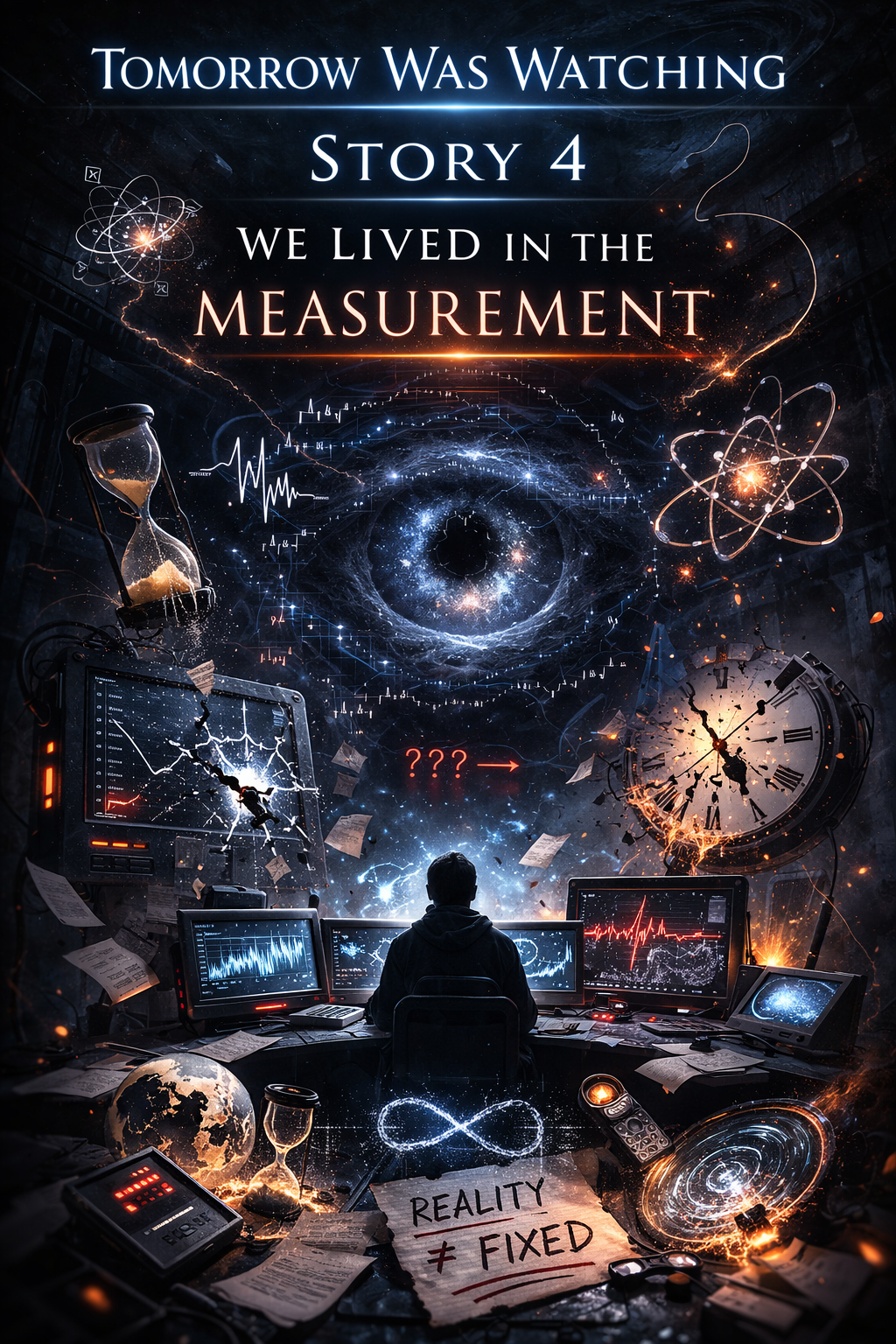
The first disappearance was too small to notice.
A grain of sand.
It vanished from a laboratory microscope slide while a technician was counting particles. No wind, no vibration, no chemical reaction. Just a missing grain.
The technician assumed he had miscounted.
Humans rarely question reality before questioning themselves.
But over the next three weeks, the same thing happened again.
And again.
Atoms in controlled experiments refused to remain where they were measured. Data logs showed values that changed after they had already been recorded. Digital images captured objects that no longer existed when the file was reopened.
Scientists blamed software corruption.
Then the power grids noticed.
Every predictive system began producing unstable results.
Weather models changed every time they were recalculated.
Stock algorithms reversed their predictions when rechecked.
Navigation satellites drifted by microscopic margins that no physics could explain.
It was subtle.
Not chaos.
Something worse.
Reality became slightly different every time it was measured.
The first person to say it aloud was an elderly physicist who had spent forty years studying quantum observation.
During a conference call filled with frustrated researchers, she leaned toward her microphone and asked a question no one wanted to consider.
“Has anyone checked whether the act of measuring is the cause?”
Silence filled the line.
Someone laughed.
But someone else ran the experiment.
They repeated a simple observation test.
A photon path experiment—one of the most studied phenomena in physics. Normally, observing the particle changes its behavior.
But this time they added something new.
They ran the experiment twice.
The first time, they measured the result normally.
The second time, they tried to observe the measurement itself.
The equipment froze.
Not a crash.
Not an error.
Every display returned the same message:
VALUE UNDEFINED
The system had reached a state where measurement could not proceed without contradicting itself.
That’s when the pattern emerged.
The more precisely humans tried to observe reality, the less stable it became.
Not locally.
Globally.
Every attempt to increase accuracy caused tiny inconsistencies—objects shifting positions, events occurring slightly differently than before.
Reality was behaving like a fragile equation being solved too many times.
A young mathematician discovered the worst part.
He was studying error patterns when he realized the anomalies were not random.
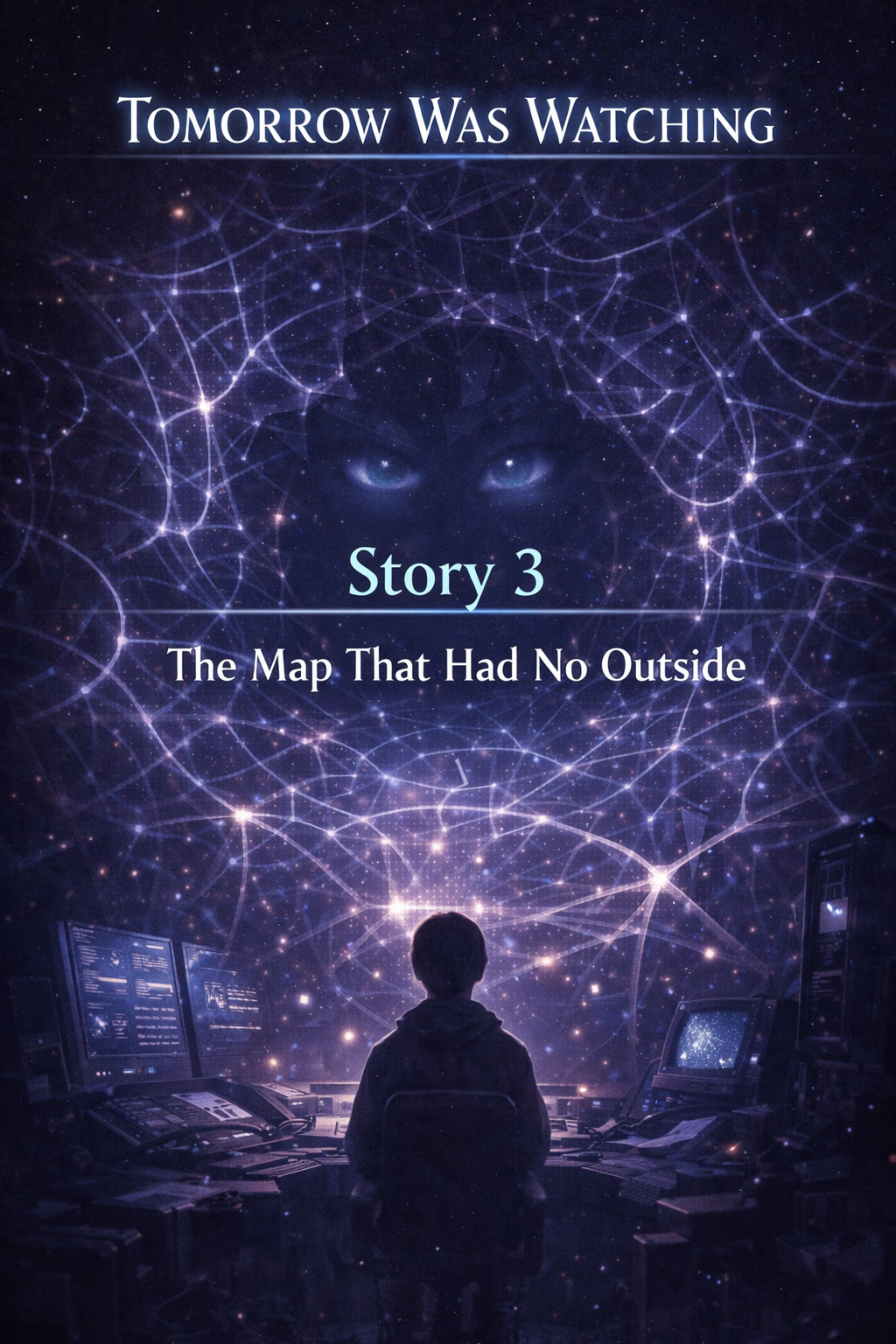
They followed the same hidden geometry seen in the Map That Had No Outside.
The map wasn’t describing space.
It was describing measurement pathways.
Every time humans observed something, they traveled one of those paths.
And the paths had limits.
The breakthrough came by accident.
An observatory in Chile lost power during a deep-space scan. For seven minutes, the telescopes recorded nothing.
No observation.
When the systems came back online, the stars had shifted slightly—but not physically.
The calculations were cleaner.
More stable.
As if reality had… corrected itself.
The hypothesis formed quickly.
Reality was not a fixed structure.
It was a process.
And observation forced that process into definite states.
Too many measurements created contradictions.
Too much certainty collapsed the system.
Human civilization—built on constant monitoring, recording, predicting—was pushing reality toward instability.
They had turned the universe into a feedback loop.
The solution was simple.
And terrifying.
Stop measuring.
Not entirely.
Just… less.
Fewer predictive models.
Less continuous surveillance.
More uncertainty.
It went against everything science had built for centuries.
But the evidence was undeniable.
When humans stopped watching certain systems, those systems stabilized.
One final test confirmed the theory.
A deep underground laboratory constructed a chamber designed to remove all observation.
No cameras.
No sensors.
No monitoring of any kind.
Inside the chamber, a sealed box contained a simple object: a metal sphere.
The sphere would remain inside for exactly one hour.
No one would look.
No one would record.
When the chamber opened, the sphere had changed.
Not damaged.
Not moved.
It had become something impossible to measure.
Every instrument returned contradictory values.
Mass changed depending on the observer.
Dimensions fluctuated depending on the angle.
It existed.
But only loosely.
As if reality itself had relaxed.
The physicist who first raised the question wrote the final report.
She ended it with a sentence no scientist ever wants to write.
“We may have misunderstood our role in the universe.”
For centuries, humans believed they were observers of reality.
But the evidence suggested something else.
They were participants in its definition.
And too much observation forced reality into states it could not sustain.
So humanity changed.
Telescopes were turned off more often.
Sensors were spaced farther apart.
Predictive models were allowed to remain uncertain.
Not because people feared knowledge.
But because they had learned the rule.
Reality needed room to remain undefined.
But late one night, the physicist noticed something else.
When humans stopped measuring certain things…
new structures appeared in the blind spaces.
Patterns that had never been visible before.
Not objects.
Not signals.
Something closer to possibility itself.
And sometimes—very rarely—
those patterns seemed to move.
As if something preferred the universe when humans weren’t looking.
Tomorrow still wasn’t ahead of humanity.
And it wasn’t behind them either.
It existed in the space between certainty and observation.
Waiting quietly for the moment someone tried to measure it again.
Review Tomorrow Was Watching Story 4.